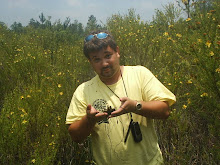
I knew very early the theme for my trip's second day: rain. It was raining when we left Bethesda, and drove (thankfully) against the traffic up to Fredericksburg, where we got back on our favorite US highway- US-15. It was a short drive up to Gettysburg, and we took the business route towards town to see what was there. Piers revealed that he double majored in biology and history, so he had interests in Gettysburg other than biology. We didn't have much time to site-see though, and headed to the Visitor's Center in the Military Park, in search of a good map. It was still under construction, and had a lot of gravelly trails headed through loose forests, so rather than get the map, we took a look around. By now the rain was pretty steady and I was soaked, so it didn't matter that I had to get a little wet to cross a small stream.
The only moss of interest I found, though, was Physcomitrium pyriforme, a moss that has haunted us over the first two days. It's a member of the same family as Funaria (the Funariaceae), and from a distance (say, standing over a patch), the sporophytes look similar. However, Physcomitrium has a rather distinct capsule when examined up close: it's pyriform, as the species name suggests. Funaria, meanwhile, has a much more elongated capsule, so much so that it sometimes bends over. Anyway, same family, similar look, similar habitats mean that we both frequently bent over to examine what was ultimately the wrong moss. It's a bummer, but it eventually yielded results- after about an hour Piers found a few small patches of F. flavicans.
Since we were both soaked, we were content on staying on the highway from Gettysburg to Harrisburg. Once there he suggested we stop at a railway; it seemed like the area was a loading site, as there were a lot of tractor trailers. There was also a lot of dirty, disturbed soil, which we poked around in for a while. The main mosses here were Bryum argenteum again (which I collected from on top of gravel on an abandoned trailer), and Ceratodon purpureus, another weedy moss commonly studied for population genetics. Stuart McDaniel, who graduated from the same lab as me in 2005, did his PhD research on the species. But it's not my species, and moved on across the Susquehanna River; I didn't find either Bagel Street, nor the hat company.
The plan was to get on PA-443, which hugs the base of the Appalachian Mountains in Pennsylvania. Right as we got on it, we passed over the same train tracks as our last stop. The only way down was a "No Outlet" street called "Cemetery Road." Pretty fitting, combining our two most common destinations; perhaps that would breed good luck. We drove down it as far as we could and walked out to the tracks. Funaria, everywhere! Along a 200 foot transect, I collected 13 different patches, on both sides of the tracks. When I was done, I put them in a bag marked: Funaria: Mother Lode. If only I knew how wrong I was.
We were content to put a good bit of distance between us and the Mother Lode population, mostly since I hadn't eaten lunch yet and it was still a steady, chilly rain. After we did stop, a decision was made to take a country road, PA-895, towards Palmerton, the coal-contaminated town a bit north of Allentown, PA. We thought it would be more direct, but it was a lot more windy, and had a lot more small towns scattered around. One of them was Auburn, PA, and as we left, we went under a train tressel. Piers suggested we stop and I followed him around the sparse, blackened forest unsuccessfully (moss-wise). We then scaled the steep up to the tracks and....
...Clearly, I did not know what Mother Lode meant. This population was huuuuuuge! Now, for a moss that might be tough to imagine, but we walked about 400 feet on both sides of the train tressel and found patches all over the place, ranging from small (2 cm wide) to large (20-30 cm). One thing I found very interesting is that the setae (plural of seta: remember it's the stalk that the capsule is on) were very variable. Some of them were quite short (2 cm) while others were quite long (10-15 cm) by moss standards. One question I have about this is whether it's due to genetics, or to environment. I will have to do experiments, growing different varieties in the same environment, to determine this. If it is genetic, I will be able to determine if there is a correlation between seta height and relatedness: generally, are inbred mosses characterized by short seta?
We spent over ninety minutes at this site, and I collected 58 patches on both sides of the tracks. By the time I had gotten all the bags laid out, I then needed to measure the distances. About then, we heard a rumbling.... and a small train whisked by, sending alot of my bags flying! I was initially very mad, but then I remembered that all the bags were numbered, and Piers had placed a stick near every population as he walked by, so it was easy to put the bags back home. They (and we) were soaked through when we got back to the car, where we quickly transcribed all the info and rebagged the mosses. It was a ridiculously successful day, and we still had two hours of light left!
It was now clear that railroad tracks were the way to go. We opened our trusty Pennsylvania gazeteer to follow the tracks... and as we approached Palmerton we went where the map said we should find a choo-choo, but there was nothing. Piers asked the postmaster of scenic East Penn, PA, and he said the tracks had been removed, but there was still a trail where they used to be. We went there and searched for a while, but only found a few small patches- I'm spoiled by Mother Lodes, for sure.
We called it a day without getting to Palmerton. I don't think I'll regret it, as I slave away under a microscope this summer, measuring the thousands of plants we collected today. Tomorrow's plan: Ithaca is Gorges! It's a short, 2-hour drive from Scranton to Ithaca but we'll be taking our time, snaking along US-11 which apparently runs along a railway, and then over to some sites near Cornell that Jon Shaw suggested. The forecast calls for a lot less rain, but also a lot less temperature. Sounds like a multi-layer day.
Miles Traveled: 200
Funaria Populations: 4
The only moss of interest I found, though, was Physcomitrium pyriforme, a moss that has haunted us over the first two days. It's a member of the same family as Funaria (the Funariaceae), and from a distance (say, standing over a patch), the sporophytes look similar. However, Physcomitrium has a rather distinct capsule when examined up close: it's pyriform, as the species name suggests. Funaria, meanwhile, has a much more elongated capsule, so much so that it sometimes bends over. Anyway, same family, similar look, similar habitats mean that we both frequently bent over to examine what was ultimately the wrong moss. It's a bummer, but it eventually yielded results- after about an hour Piers found a few small patches of F. flavicans.
Since we were both soaked, we were content on staying on the highway from Gettysburg to Harrisburg. Once there he suggested we stop at a railway; it seemed like the area was a loading site, as there were a lot of tractor trailers. There was also a lot of dirty, disturbed soil, which we poked around in for a while. The main mosses here were Bryum argenteum again (which I collected from on top of gravel on an abandoned trailer), and Ceratodon purpureus, another weedy moss commonly studied for population genetics. Stuart McDaniel, who graduated from the same lab as me in 2005, did his PhD research on the species. But it's not my species, and moved on across the Susquehanna River; I didn't find either Bagel Street, nor the hat company.
The plan was to get on PA-443, which hugs the base of the Appalachian Mountains in Pennsylvania. Right as we got on it, we passed over the same train tracks as our last stop. The only way down was a "No Outlet" street called "Cemetery Road." Pretty fitting, combining our two most common destinations; perhaps that would breed good luck. We drove down it as far as we could and walked out to the tracks. Funaria, everywhere! Along a 200 foot transect, I collected 13 different patches, on both sides of the tracks. When I was done, I put them in a bag marked: Funaria: Mother Lode. If only I knew how wrong I was.
We were content to put a good bit of distance between us and the Mother Lode population, mostly since I hadn't eaten lunch yet and it was still a steady, chilly rain. After we did stop, a decision was made to take a country road, PA-895, towards Palmerton, the coal-contaminated town a bit north of Allentown, PA. We thought it would be more direct, but it was a lot more windy, and had a lot more small towns scattered around. One of them was Auburn, PA, and as we left, we went under a train tressel. Piers suggested we stop and I followed him around the sparse, blackened forest unsuccessfully (moss-wise). We then scaled the steep up to the tracks and....
...Clearly, I did not know what Mother Lode meant. This population was huuuuuuge! Now, for a moss that might be tough to imagine, but we walked about 400 feet on both sides of the train tressel and found patches all over the place, ranging from small (2 cm wide) to large (20-30 cm). One thing I found very interesting is that the setae (plural of seta: remember it's the stalk that the capsule is on) were very variable. Some of them were quite short (2 cm) while others were quite long (10-15 cm) by moss standards. One question I have about this is whether it's due to genetics, or to environment. I will have to do experiments, growing different varieties in the same environment, to determine this. If it is genetic, I will be able to determine if there is a correlation between seta height and relatedness: generally, are inbred mosses characterized by short seta?
We spent over ninety minutes at this site, and I collected 58 patches on both sides of the tracks. By the time I had gotten all the bags laid out, I then needed to measure the distances. About then, we heard a rumbling.... and a small train whisked by, sending alot of my bags flying! I was initially very mad, but then I remembered that all the bags were numbered, and Piers had placed a stick near every population as he walked by, so it was easy to put the bags back home. They (and we) were soaked through when we got back to the car, where we quickly transcribed all the info and rebagged the mosses. It was a ridiculously successful day, and we still had two hours of light left!
It was now clear that railroad tracks were the way to go. We opened our trusty Pennsylvania gazeteer to follow the tracks... and as we approached Palmerton we went where the map said we should find a choo-choo, but there was nothing. Piers asked the postmaster of scenic East Penn, PA, and he said the tracks had been removed, but there was still a trail where they used to be. We went there and searched for a while, but only found a few small patches- I'm spoiled by Mother Lodes, for sure.
We called it a day without getting to Palmerton. I don't think I'll regret it, as I slave away under a microscope this summer, measuring the thousands of plants we collected today. Tomorrow's plan: Ithaca is Gorges! It's a short, 2-hour drive from Scranton to Ithaca but we'll be taking our time, snaking along US-11 which apparently runs along a railway, and then over to some sites near Cornell that Jon Shaw suggested. The forecast calls for a lot less rain, but also a lot less temperature. Sounds like a multi-layer day.
Miles Traveled: 200
Funaria Populations: 4